Showing posts with label Free Market Wankery. Show all posts

Thursday, January 5, 2012

The American Dream Co-Opted By Pesky Foreigners

Today marks my re-entry into blogging after a several month long hiatus for a number of personal reasons. Didn't feel like doing it, so I didn't. I figured if my heart wasn't in it, then there was really no point. That being said, I'm glad to be back on (off?) the wagon. It's a new year - an election year no less - and there is bound to be an innumerate amount of issues to write about and discuss.

Issues like this one:
But many researchers have reached a conclusion that turns conventional wisdom on its head: Americans enjoy less economic mobility than their peers in Canada and much of Western Europe. The mobility gap has been widely discussed in academic circles, but a sour season of mass unemployment and street protests has moved the discussion toward center stage.
[...]
At least five large studies in recent years have found the United States to be less mobile than comparable nations. A project led by Markus Jantti, an economist at a Swedish university, found that 42 percent of American men raised in the bottom fifth of incomes stay there as adults. That shows a level of persistent disadvantage much higher than in Denmark (25 percent) and Britain (30 percent) — a country famous for its class constraints.
[...]
While liberals often complain that the United States has unusually large income gaps, many conservatives have argued that the system is fair because mobility is especially high, too: everyone can climb the ladder. Now the evidence suggests that America is not only less equal, but also less mobile.
[...]
In 2006 Professor Corak reviewed more than 50 studies of nine countries. He ranked Canada, Norway, Finland and Denmark as the most mobile, with the United States and Britain roughly tied at the other extreme. Sweden, Germany, and France were scattered across the middle.
Read the whole thing. As the article says, the issue isn't that people don't have money or decent paying jobs (although that is obviously a separate issue) but rather that the American Dream is under assault. That is, it is increasingly statistically difficult, if not impossible, to be born in one economic strata and be able to move to a higher one through sheer force of will and hard work. That was the essence of the American Dream - that anyone that played by the rules and had an exceptional work ethic could become upper middle class, or at least significantly better themselves. Not so anymore, at least in most cases. That fairy tale has been left behind in our collective rear view mirror in the 1950s. And don't be fooled by the financial crisis/recession - this has been decades in the making. 

This is what happens when the de facto economic policy of the US is wildly tilted towards the highest echelons of the economic ladder in hopes that magical fairies and wildly generous and wealthy benefactors will trickle down their gains and table scraps to the rest of us. You'll note that the common denominator here is that the countries in the article with superior economic mobility do not subscribe to such fantasies. They have higher taxes on the high earners/wealth (sorry - the job creators) and don't believe in the infantile fallacy that if you give the wealthy shit for free, they give it away to the rest of us and make it rain because they are just that generous.

Occupy Wall Street is a start, and a good one at that. And people outside the movement are even starting to catch on - despite the abject failure of Washington and both political parties (with heavier blame on the GOP), public opinion wildly favors progressive economic policies. And I would venture to guess that a solid majority of the country would be very pleased with the results of a true progressive tax code and higher taxation on those who have done well if they would simply remove their heads from their collective asses and realize that they themselves are a part of the very statistics that this article details. This is what the 2012 election should be about (but probably won't be). Hopefully this dialog will continue into the future. Our political overlords would be incredibly stupid to ignore the dialog that OWS has started.

Tuesday, October 11, 2011

We're Putting New Cover Sheets On All the TPS Reports Now

Mother Jones does a great job with some of the visual pieces it runs with various data illustrating our economic stratification. I frequently link to this one about income inequality, because it is simply indispensable for illustrating just how far down the plutocracy rabbit hole we have ventured. But they have another great illustrated feature up called Overworked America that is well worth your time. 

I think one of the most shocking and saddest chart is the one where it shows that most of the African continent requires paid maternity leave. The US still has no such requirement. Parents must take time off through short-term disability and the Family Medical Leave of Absence Act. Short-term disability is an insurance benefit (and not 100% of your salary in most cases), and FMLA is unpaid. It just prevents your employer from firing you while you are out on FMLA approved leave.

So yeah. We are behind Africa in the benefits we afford to new mothers. Africa. You know, that giant chunk of land south of Europe and Asia that doesn't exactly boast a reputation of modern, civilized democracies but more often than not brings to mind images of genocide, famine, sectarian violence, and civil war. That's the continent that affords mandatory paid maternity leave. Not ours.

Thursday, October 6, 2011

Breaking: People Having Money = Economic Growth

No one could have predicted that income inequality stifles economic growth:
"Countries where income was more equally distributed tended to have longer growth spells," says economist Andrew Berg, whose study appears in the current issue of Finance & Development, the quarterly magazine of the International Monetary Fund. Comparing six major economic variables across the world's economies, Berg found that equality of incomes was the most important factor in preventing a major downturn. 
In their study, Berg and coauthor Jonathan Ostry were less interested in looking at how to spark economic growth than how to sustain it. "Getting growth going is not that difficult; it's keeping it going that is hard," Berg explains. For example, the bailouts and stimulus pulled the US economy out of recession but haven't been enough to fuel a steady recovery. Berg's research suggests that sky-high income inequality in the United States could be partly to blame. 
So how important is equality? According to the study, making an economy's income distribution 10 percent more equitable prolongs its typical growth spell by 50 percent.
Clearly what this study misses is that it has not taken a long enough view or a large enough sample set to account for the trickle down from the plutocrats. You just need to wait longer, you impatient anti-American, capitalist hating asshole.

Friday, September 30, 2011

It's the Weak Demand, Stupid

Paul Krugman debunks the conservative/teabagger red herring that CRUSHING REGULATIONS, "uncertainty," highest taxes ever, and President Obama's perpetual bruising of bankster and executive fee-fees are to blame for our faltering economy:
Listen to just about any speech by a Republican presidential hopeful, and you’ll hear assertions that the Obama administration is responsible for weak job growth. How so? The answer, repeated again and again, is that businesses are afraid to expand and create jobs because they fear costly regulations and higher taxes. Nor are politicians the only people saying this. Conservative economists repeat the claim in op-ed articles, and Federal Reserve officials repeat it to justify their opposition to even modest efforts to aid the economy. 
The first thing you need to know, then, is that there’s no evidence supporting this claim and a lot of evidence showing that it’s false. 
[...] 
Isn’t there something odd about the fact that businesses are making large profits and sitting on a lot of cash but aren’t spending that cash to expand capacity and employment? No. 
After all, why should businesses expand when they’re not using the capacity they already have? The bursting of the housing bubble and the overhang of household debt have left consumer spending depressed and many businesses with more capacity than they need and no reason to add more. Business investment always responds strongly to the state of the economy, and given how weak our economy remains you shouldn’t be surprised if investment remains low. If anything, business spending has been stronger than one might have predicted given slow growth and high unemployment. 
But aren’t business people complaining about the burden of taxes and regulations? Yes, but no more than usual. Mr. Mishel points out that the National Federation of Independent Business has been surveying small businesses for almost 40 years, asking them to name their most important problem. Taxes and regulations always rank high on the list, but what stands out now is a surge in the number of businesses citing poor sales — which strongly suggests that lack of demand, not fear of government, is holding business back.
Republicans and Very Serious People do not want to listen to this reality, but prefer to live in their own contrived Randian fantasy land, because subscribing to facts and reality would mean embracing a demand-side, Keynesian view of economic policy, which is inherently at odds with the snake oil that they traffic on a daily basis. And we all know that what really ails America is that corporations and banksters and plutocrats don't have enough free money.

Sunday, September 25, 2011

Or We Could Just Ban It

Once upon a time, the modern derivative/future/forward contract was born, and incredibly useful financial instrument that helps anyone from ordinary farmers protecting themselves against the risk of falling prices at harvest, to airline giants seeking to limit their exposure to ever-rising fuel prices. The forward was a prudent tool, whereby two parties entered into an financial exchange - one party essentially betting that the price of the commodity would rise, while the counterparty expecting that same price to fall. Historically, these contracts actually involved the physical transfer and delivery of the underlying asset. So when that farmer bought a forward contract to sell bushels of wheat at some specified price, the counterparty would actually buy those bushels of wheat from the farmer at the specified date, at the specified price.

But like everything in American and global finance, this has been turned into a giant fucking casino whereby it primarily serves the purpose of funneling around huge sums of money in search of short-term profits while doing very little to actually serve its original purpose. The farmers and Southwest Airlines of the world now make up a very small percentage of these forwards. This makes some people enormously wealthy, while passing on the costs of rampant speculation to the rest of us in the form of rising commodity prices, especially oil.

So here's an idea - how about an outright ban on speculative hedging? It's not like there aren't a million other ways for banksters and "job creators" to slosh around their casino funds. There is some work being done on this now both by the Dodd-Frank act and Sen. Ben Nelson, of all people, but you can guarantee that it won't go far enough or even make it out of the gate with the kind of money this makes. When up to 25% of the cost of a barrel of oil is estimated to be due to this excessive speculation, you would think that it would be a common sense policy to rein it in for the sake of the American economy. Rising oil prices are overwhelmingly detrimental to our consumption based economy. But it's big business for the banksters, so don't expect to see any common sense policy any time soon.

Friday, September 23, 2011

The Cuts Will Continue Until Markets Improve

The answer to all of this, of course, is more austerity. The Free Market Jebus is punishing us for insufficient fealty to his whims. We're going to shrink our way out of this recession!

Sunday, September 18, 2011

Former Google CEO Eric Schmidt: Evil Socialist

You can now add Eric Schmidt to the Right's growing list of wildly successful capitalists Unserious evil dirty socialist scum: 
But the current strategy is ludicrous. You have a situtation where the private sector sees essentially no growth in demand. The classic solution is to have the government step in, and with short-term initiatives help stimulate that demand. If they do it right, they'll invest in income and growth producing things, like highways and bridges and schools. 
[...] 
Business can create enormous numbers of new jobs in America. All we need to see is more demand. What's happening right now is: Businesses are very well-run, they have a lot of cash. They're waiting for more demand. At the moment, business efficiency allows them to grow at 1 or 2 percent, which is what we're seeing today. They don't have to hire more people. And until we solve the problem, people are going to sit idle. And it's a real tragedy.
Other recent and prominent additions to this list include Warren Buffet, for his audacity to point out the fact that the mega rich pay absurdly low, regressive levels of taxes.

Saturday, September 17, 2011

Freedom of Coercing Small Children to Work for Shit Wages

Media Matters is on a roll lately, or maybe it's just the stupid people that feed them their material. At any rate, since the Republicans and Tea Baggers are such huge fans of third world policies and third world standards of living, I for one welcome them to just shut the fuck up and collectively move themselves to a true third world nation (remember, we're only aspiring to be one at this point) and see how much they love the awesomeness and freedom and stuff.

And for all you "But Fox is fair and balanced!" types, I think it's just adorable how they are barnstorming  wall-to-wall coverage of the exact same agenda that Republicans in Congress settled on coming out of the August recess.

Saturday, July 30, 2011

C+I+G+(E-I) = GDP

Real murikans don't care bout no fancy elitist economic "theories":
Notable contributions to real GDP growth in the second quarter included net exports (0.6 percentage points) and fixed investment (0.7 p.p.). Defense spending added 0.4 p.p. to GDP, but this gain was offset by declines in state and local government (-0.4 p.p.) and nondefense spending (-0.2 p.p.). Consumer spending rose just 0.1 percent at an annual rate, with a steep decline (23 percent) in motor vehicle consumption accounting for the weakness. The downward revision to first quarter GDP from 1.9 percent to 0.4 percent reflects lower contributions from inventory investment and imports.
Just to recap - consumer spending is in the shitter because millions are out of work (or afraid of losing their job), or otherwise deferring most purchases as they deleverage from the cheap credit spending binge of the early to mid 2000s bubble. Gross investment suffers a similar fate as consumers and businesses alike hoard their cash in fear of flagging aggregate demand. Net exports are perhaps the one bright spot.

So do some math with me here. Your goal is to increase GDP. When three of the four primary factors that make up gross domestic product have plodded along through a historic recession and one of the weakest economies on record, what do you do? Oh, and keep in mind that for the other factor, government spending, you can borrow money at historically low interest rates (~3%) as investors around the world flee to Treasury securities as one of the few safe investments left on the planet. 

If your answer is "slash government spending" or "do nothing and hope that the confidence fairies and free market Jebus bless us in the face," then congratulations: you have a future in American politics. Government spending is perhaps the one economic factor favorably within our control, and the American government is running away from screaming with their fingers in their ears like a bunch of children. Yes, we have a very large deficit, but we also have a much more pressing and grim short-term economic outlook. 

Not to mention the amount of disgusting cynicism it shows on the President's part that he values the ignorant whims of independent voters over the plight of the unemployed. Or just how how incredibly stupid that sounds when you think about it. Independents think that we should spend less. Why? Just because! Okay then! We better give them what they want, especially after the 2010 "shellacking."

You know what else independents might like? An unemployment rate somewhere south of 9.2%. Just a hunch. 

Thursday, July 7, 2011

The Rich Get Richer

Obama has got to stop hurting these guys fee-fees with his corporate jet class warfare. They just have it so hard as it is:
The final figures show that the median pay for top executives at 200 big companies last year was $10.8 million. That works out to a 23 percent gain from 2009. The earlier study had put the median pay at a none-too-shabby $9.6 million, up 12 percent.
Total C.E.O. pay hasn’t quite returned to its heady, prerecession levels — but it certainly seems headed there. Despite the soft economy, weak home prices and persistently high unemployment, some top executives are already making more than they were before the economy soured.
Pay skyrocketed last year because many companies brought back cash bonuses, says Aaron Boyd, head of research at Equilar. Cash bonuses, as opposed to those awarded in stock options, jumped by an astounding 38 percent, the final numbers show.
Granted, many American corporations did well last year. Profits were up substantially. As a result, many companies are sharing the wealth, at least with their executives. “We’re seeing a lot of that reflected in the pay,” Mr. Boyd says.
It's the American way: concentrate all the wealth and compensation at the very top, because those people need to have all the money - they create the jobs and trickle stuff down on us! And things! For everyone else, expect them to do more with less, oftentimes the jobs of maybe two to three people because of massive recessionary layoffs, and pay them the same wages with minuscule adjustments (if any) that barely cover recent increases to the cost of living. It's a great racket too; the economy continues to suck because our political class thinks austerity is the panacea for 10% GDP, so the workers are terrified of losing the gig they have, or demanding more in pay, or being able to find work elsewhere. 

And next time some asshole Republican puffs his chest about how we have to keep taxes low and can't raise them ever, think of this gilded motley crew:
The preliminary and final studies put Philippe P. Dauman, the chief executive of Viacom, at the top of the list. Mr. Dauman made $84.5 million last year, after signing a new long-term contract that included one-time stock awards.
Leslie Moonves, of the CBS Corporation, got a 32 percent raise and reaped $56.9 million. Michael White of DirecTV was paid $32.9 million, while Brian L. Roberts of the Comcast Corporation and Robert A. Iger of the Walt Disney Company each received pay packages valued at $28 million.
“Media firms seemed to be paying a lot,” said Carol Bowie, head of compensation policy development at ISS Governance, which advises large investors on corporate governance issues like proxy votes. “Media companies in general tend to be high-payers, and they tend to feed off each other.”
Other big payers included oil and commodities companies like Exxon Mobil and a few technology giants like Oracle and I.B.M.
Some of the other highly paid executives on the new list who were not in the April survey are Gregg W. Steinhafel of Target, who had a $23.5 million pay package; Michael E. Szymanczyk of Altria, $20.77 million; and Richard C. Adkerson of Freeport-McMoRan Copper & Gold, $35.3 million.
Republicans want to abolish your Medicare, your Social Security, even your roads, all so these guys can keep their 6 or 8 (or more, who knows) vacation homes with Lambos parked in front of each of them.

But don't worry - with the top 0.1% holding all the wealth, they will eventually trickle it down and create jobs with Western European levels of healthcare and retirement benefits. Just you wait.

Friday, July 1, 2011

Kevin Drum is Shrill

And by Halperin standards, kind of a dick:
But then, for about the thousandth time, my mind wanders over the past ten years. Republicans got the tax cuts they wanted. They got the financial deregulation they wanted. They got the wars they wanted. They got the unfunded spending increases they wanted. And the results were completely, unrelentingly disastrous. A decade of sluggish growth and near-zero wage increases. A massive housing bubble. Trillions of dollars in war spending and thousands of American lives lost. A financial collapse. A soaring long-term deficit. Sky-high unemployment. All on their watch and all due to policies they eagerly supported. And worse: ever since the predictable results of their recklessness came crashing down, they've rabidly and nearly unanimously opposed every single attempt to dig ourselves out of the hole they created for us.
But despite the fact that this is all recent history, it's treated like some kind of dreamscape. No one talks about it. Republicans pretend it never happened.
I'd say that's about right.

(Via Greg Sargent)

It's the Banksters' World

We are just living in it.
Then there are the more subtle subsidies and protections. Take regulatory forbearance. In 2009, regulators gave banks a gift on their commercial real estate loans. They allowed banks to look primarily at whether the loans were current, rather than at whether the underlying value of the property had declined. Of course, given the commercial real estate collapse, this had the effect of protecting banks from write-downs.
Banks and regulators say this is justified because an underwater borrower isn’t necessarily going to default. True, but it’s hard to see how those borrowers — and therefore the banks — are better off for the crash in their collateral.
[...]
Another way taxpayers coddle the biggest banks is by implicitly guaranteeing their derivatives business. JPMorgan, widely viewed as safe and well managed, is a huge beneficiary here. It had $79 billion worth of derivatives on its books in the first quarter. Even if it’s hedged, prudent and has thin margins, it’s still going to throw off a nice chunk of profits.
Institutions on the other side of these trades wouldn’t enter contracts without believing that they have some underlying protection — protection that comes from the government.
“No sensible person would put a nickel on deposit in the normal course given the enormity and opacity of the derivatives portfolios,” said Amar Bhidé, a former trader and business professor at the Fletcher School. “It’s entirely a function of deposit insurance and the implicit guarantee that the JPMorgan counterparties have.”
The government’s actions in the financial crisis only cemented that certainty. Counterparties and investors that were previously not guaranteed, like holders of money market funds, were protected at every turn.
This bailout never ended. “In effect, we nationalized the biggest banks years ago,” Mr. Allison said. “We implicitly guaranteed them. The taxpayers are still the ultimate owners of the risk in those banks — they just don’t get equity returns for that ownership.”
We here in murika believe in the free market so much that we shield the banksters from ever being exposed to its ills. 

(Via Atrios)

Tuesday, June 7, 2011

Republican Healthcare Policy: Universal Repeal

No one could have predicted that the GOP's "repeal and replace" slogan on the Affordable Care Act was really just "repeal":
More than four months after their triumphant vote to scrap the Democrats' healthcare reform law, House Republicans have yet to fulfill the second part of their campaign pledge to "repeal and replace" the legislation.
Republicans say healthcare has taken a back seat to issues like the debt ceiling and Medicare reform but stress that they have a number of reform proposals up their sleeve.
"Our focus right now is on repealing all of ‘Obamacare’ and pieces of it where we can," said Rep. John Kline [R-Minn.], the chairman of the Education and Workforce Committee, one of three panels with jurisdiction over the health policy. "And then we're working on spurring the economy and getting America back to work with jobs.
“The replacement pieces for healthcare are still on the table,” Kline said, “but we're not pushing them right now because we've got a full plate with other stuff."
God, we're busy with other stuff and things guys, okay?! We just haven't had a chance to get to the "replace" part yet!

Perhaps their "full plate with other stuff" includes Paul Ryan's budget, which again, is another "repeal" scheme without the "replace," as Paul Krugman aptly notes:
I’m seeing many attempts to shout down anyone making this obvious point, and not just from Republican politicians. For some reason, many commentators seem to believe that accurately describing what the G.O.P. is actually proposing amounts to demagoguery. But there’s nothing demagogic about telling the truth.
Start with the claim that the G.O.P. plan simply reforms Medicare rather than ending it. I’ll just quote the blogger Duncan Black, who summarizes this as saying that “when we replace the Marines with a pizza, we’ll call the pizza the Marines.” The point is that you can name the new program Medicare, but it’s an entirely different program — call it Vouchercare — that would offer nothing like the coverage that the elderly now receive. (Republicans get huffy when you call their plan a voucher scheme, but that’s exactly what it is.)
Medicare is a government-run insurance system that directly pays health-care providers. Vouchercare would cut checks to insurance companies instead. Specifically, the program would pay a fixed amount toward private health insurance — higher for the poor, lower for the rich, but not varying at all with the actual level of premiums. If you couldn’t afford a policy adequate for your needs, even with the voucher, that would be your problem.
But Democrats are meanieheads for using "Mediscare" tactics and WHAT IS THEIR PLAN FOR MEDICARE, HUH?! And it's "premium support," you jerks, which is like, totally not a voucher!

The Republican policy on healthcare across the board is that you should pretty much fuck off and hope for the best. Anyone who argues something to the contrary is lying to themselves. They are consistent on this across the board - they want nothing more than to dismantle Medicare, Medicaid, the Affordable Care Act, and any other piece of legislation that provides coverage not dictated by the supreme wisdom of the free market Jebus and the invisible hand. 

Thursday, June 2, 2011

Ratings Agencies: Strictly in the Business of Wrecking the Economy

First they ground the economy into a bloody pulp through their corrupt, systematic, and willful ignorance on accurately rating the heaping piles of shit that were mortgage-backed securities, and now their new favorite act is sending markets into a tailspin as they rattle their sabers over downgrading the U.S. credit rating:
Moody’s Investors Service warned Thursday that it might downgrade the United States government’s sterling credit rating if Congress did not increase the nation’s debt limit “in coming weeks,” putting a spur to the sputtering talks between party leaders and the White House on a plan to restore fiscal stability.
Moody’s said a review of the credit rating was “likely” in July, given that “the risk of continuing stalemate has grown.” Its warning followed a similar one from another major ratings firm six weeks ago, and it came as the administration met Thursday with both House Republicans and Democrats in search of a deal.
It's funny how they seem interested in performing any function whatsoever only when it serves as a detriment to the economy. And check out the big brass balls on this anonymous Republican:
The treasury secretary, Timothy F. Geithner, met on Capitol Hill with House freshmen, including Republicans who have suggested that they see little or no risk in a showdown over the debt limit. Citing the Moody’s statement, Mr. Geithner urged them to support raising it or risk an economic crisis.
“We didn’t create this mess,” one Republican told Mr. Geithner, according to a person in the room.
Right - I completely forgot that the Bush tax cuts, two incredibly fucking stupid wars, and Medicare Part D were all enacted and funded by deficit spending on January 20, 2009. Ass.

And I was also not aware that it was the function of independent rating agencies to take political stances:
And second, Moody’s said, with an implicit slap at both parties, that whether the United States keeps its triple-A rating “will depend on the outcome of negotiations on deficit reduction.”
Funny how we never heard a peep out of Moody's on the deficit during the Bush years, don't you think? Someone has been drinking a little heavily from the trough of conventional wisdom Kool-Aid. I bet they would get a raging free market boner if Washington were to suddenly enact a vicious austerity program that served to demolish Medicare and Social Security while cutting both corporate taxes and top marginal rates. They would have to create a new rating above AAA that would adequately reflect their excitement.

Monday, May 23, 2011

They're Trying to Build a Prison

Weird...privatizing prisons yields little cost savings, despite fervent wingnut claims to the contrary:
PHOENIX — The conviction that private prisons save money helped drive more than 30 states to turn to them for housing inmates. But Arizona shows that popular wisdom might be wrong: Data there suggest that privately operated prisons can cost more to operate than state-run prisons — even though they often steer clear of the sickest, costliest inmates
[...] 
“Unlike the private contractors,” the analysis said, the state “is required to provide medical and mental health services to inmates regardless of the severity of their condition.” Medical costs averaged up to $2.44 a day more for state inmates, a third higher than private prisons.
In Arizona, minimum-security state inmates cost 2.6 percent — or $1.39 per day — more than those in private prisons, before accounting for extra costs borne by the state. But after eliminating these, state prisoners cost only three cents more per day, the analysis found.
And state medium-security inmates cost 4.4 percent less before adjustments and 8.7 percent less afterward. That is more than $2 million annually at one prison, or $1,679 per inmate. Using 2009 corrections data, state auditors calculated the difference at up to $2,834 per inmate.
Charles L. Ryan, the Arizona corrections director, said private prisons “often negotiate restrictions on the type of inmates” and limit “inmates with medical conditions to a specific cost level.” 

So essentially, the entire prison privatization model centers around accepting only healthy or low-maintenance prisoners and then skimping on the level of basic care provided. Sounds strikingly similar to the health insurance industry. 

And this next part of the article is disgusting, and a perfect illustration of why some things in America should not be allowed to turn a profit:
The measures would be a shot in the arm for an industry that has struggled, in some places, to fill prison beds as the number of inmates nationwide has leveled off. 
Heckuva job, NYT - way to blithely state that locking up more people would be a much needed boon for the poor, beleaguered prison industry. Clearly what we need is to throw even more people behind bar (you know, despite already having the highest incarceration rate of the developed world) so that we can generate some more profits for the destitute prison industry. The shareholders demand a reasonable return on their investment!


If ever there were an argument to be made for a role of government, operating prisons/corrections should be paramount among them. There are just some industries/functions that should not be handled by private industry. 
It should be patently obvious to anyone with a pulse that profiting off of incarceration is wrong and produces horrible incentives. Take for instance another shining example of the ever-revolving door between private industry and public office: a number of Gov. Jan Brewer's top advisers are heavily connected to the private prison industry. And I suppose that we should probably just accept that their pervasive connection, material support, and assistance in drafting Arizona's anti-immigrant bill, SB1070, was purely an innocent coincidence. These titans of the prison industry just love justice and protecting our borders.

If you want cost savings in the department of corrections, I have a revolutionary idea: don't incarcerate innumerate sums of people for stupid, trivial offenses. Crazy, I know. Abolish mandatory, minimum sentences for non-violent drug offenders, decriminalize marijuana possession (a needed step in the eventual overall direction of the eventual legalization and taxation of the substance) and maybe your prisons won't be bursting at the seams. Overall violent crime rates continue to decline, yet prison populations remain flat or continue to rise, and again, are the highest in the world. There's something to be said about the relationship between those two figures. 

And fuck it - while I'm on the topic, I'll briefly note again the sheer alacrity with which we throw people in jail for smoking a joint, but we're perfectly fine with looking the other way on warrantless wiretaps, torture, indefinite detention, and the wholesale destruction and looting of the US economy by the banksters. It's a sad statement on our country's purported love of "liberty and justice for all."

Friday, May 6, 2011

The GOP: Objectively Anti-Consumer Protection

Assholes:
Nearly every Republican senator is vowing to block any presidential nominee to head the new Consumer Financial Protection Bureau (CFPB) unless major changes are made to the agency.
In a letter sent to the president Thursday, 44 GOP senators said that any pick to become the first director of the CFPB, regardless of political affiliation, will be unacceptable unless the bureau is significatly altered to reduce its "unfettered authority."
[...]
"The CFPB as created by the deeply-flawed Dodd-Frank Act is set to be one of the least accountable and most powerful agencies in Washington," said Senate Republican Leader Mitch McConnell (R-Ky.). "The reforms outlined are necessary before we will consider any nominee to head this agency.”
"This about accountability," added Sen. Richard Shelby (R-Ala.), the ranking member of the Senate Banking Committee. "The bureau, as currently structured, lacks any semblance of the checks and balances inherent in the Constitution."  
Specifically, the lawmakers are demanding the top of the CFPB be changed so that instead of being run by a single director, it is headed by a board of directors. They also want the CFPB's budget to fall under the jurisdiction of Congressional appropriators — currently the CFPB is set up to receive its budget from the Federal Reserve. And finally, they want other regulators to be able to block CFPB regulations if they deem it could endanger the safety and soundess of banks.
Right, because we all know how much Republicans care about "accountability" or reining in "unfettered power," which is they only care about it when they're not in power, or the issue in question is preventing their corporate masters from doing whatever the fuck they want.

And the "significant alterations" they are seeking would do nothing short of rendering the agency useless, which is their ultimate goal. It has nothing to do with accountability. Proposing a board of directors is their attempt to fill it with know-nothing batshit GOP ideologues to grind the agency to a gridlock of 111th/112th Congressional proportions. There is recent precedent for this; the Republican appointees to the financial crisis commission voted to remove any mention of the terms "Wall Street" or "deregulation" altogether from their commission report, and blamed the entirety of the financial crisis on poor people and minorities and the government. Placing the CPFB's budget under the jurisdiction of Congressional appropriators is another attempt to bring the agency to Congressional heel and ensure that it receives little or inadequate funding to execute its charge. You know, because we are broke, and we can't finance consumer protection when we have really important things to pay for like endless wars and tax cuts. There's actually a good argument to make that more of our financial regulation agencies should be free from Congressional budget appropriations and receive their funding through the Fed as the CPFB would.

Going on three years on now with no indictments or criminal prosecutions of any high-level parties involved with the financial crisis, and to add insult to injury, half of our Senators have their heads in the sand or are running around with their fingers in their ears screaming LA-LA-LA-LA-LA I CAN'T HEAR YOU.

Thursday, May 5, 2011

Washington's Perverse Economic Priorities

The latest example of Washington's rush to solve a non-existent problem while completely ignoring that which ails millions of Americans - corporate tax reform:
The Obama administration is quietly gearing up for a high-profile launch in May or June on what may turn out to be the most heavily lobbied issue of the year: corporate tax reform.
“This will be a feast for K Street,” said one top aide.
At a time when the two parties can find little common ground legislatively, strategists on both sides tell POLITICO they hope to advance their jobs agenda by finding a way to lower corporate tax rates.
“This would send a reassuring signal to the economy, and is something both parties should support in theory,” a senior administration official said, predicting “a numbers game” in which companies and industries ferociously litigate the fine points.
Treasury Secretary Timothy Geithner plans to ignite the debate by unveiling a white paper that advocates lowering the top corporate tax rate from the current 35 percent to less than 30 percent and as low as 26 percent, according to aides. The proposal is likely to fall between 26 percent and 28 percent.
To pay for that, the proposal will call for closing loopholes and slicing exemptions. The two main ones are a tax deduction for domestic manufacturing and accelerated depreciation for capital equipment.
Got that? Reducing corporate taxes is a "jobs agenda." Pervasive unemployment, a housing market in a continued tailspin, GDP in the shitter and barely strong enough to keep us from backsliding into another recession, and Washington's idea of an economic priority is...corporate tax reform. But it would send a reassuring signal to the economy, and we all know how important it is to stroke the delicate fee-fees of the economy (and our plutocrats) while categorically ignoring the economic hardships of millions of Americans. I hear markets get a real boner for that kind of thing. And why shouldn't we tackle corporate tax reform? You know, because our poor, beleaguered corporations are just struggling so hard right now! They can't compete or innovate globally with our punitive Highest Tax Rate in the World!
All told, the Fortune 500 generated nearly $10.8 trillion in total revenues last year, up 10.5%. Total profits soared 81%. But guess who didn’t benefit much from this giant wave of cash? Millions of U.S. workers stuck mired in a stagnant job market. [...] Nevertheless, we’ve rarely seen such a stark gulf between the fortunes of the 500 and those of ordinary Americans.
And they are now even considering the much maligned, corporate giveaway that creates zero jobs, unless you define jobs as bonuses for executives and dividends for shareholders.
One possibility for the administration white paper is a move toward a more territorial system that is consistent with taxation schemes in the rest of the developed world, focused on taxing profits earned in the U.S. Such a provision would probably include a transitional measure that allowed companies to move profits earned abroad back to the U.S. at a lower tax rate — say, 10 percent.
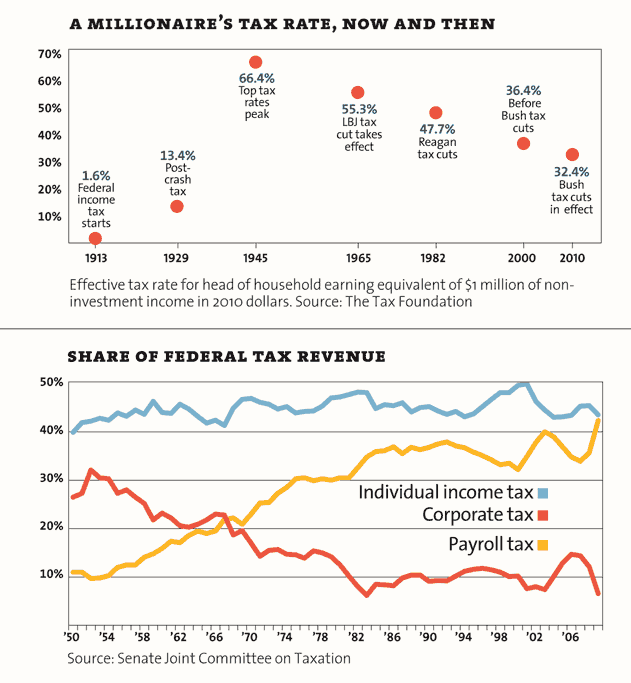
It's amazing what a few million dollars in lobbyists can buy you, and it's maddening to watch them fuss over lowering the marginal rate when pretty much zero corporations actually pay the top marginal rate to begin with. Whatever the "grand bargain" ends up being, expect it to be supremely corporation-friendly and likely put them in a position to be paying even less than they are now. The Chamber of Commerce will send their army of lobbyists in and crack the whip at their foot soldiers in Congress, who will promptly do their bidding, sell it as an enormous bipartisan success, and then head off to a cocktail party to discuss the intricacies of their post public service employment in the same companies to which they just gave an enormous slobbery legislative blow job.

There's no shortage of reasons why this is completely ridiculous, one of them being that corporate taxes as a share of federal revenue are at record lows:

And the evil socialists at the Congressional Budget Office have found that a significant number of American corporations pay no taxes at all:
But by taking advantage of myriad breaks and loopholes that other countries generally do not offer, United States corporations pay only slightly more on average than their counterparts in other industrial countries. And some American corporations use aggressive strategies to pay less — often far less — than their competitors abroad and at home. A Government Accountability Office study released in 2008 found that 55 percent of United States companies paid no federal income taxes during at least one year in a seven-year period it studied.
I'm not saying that the current system is perfect. But it's disgusting to focus on corporate welfare while millions are struggling, even if you try to assuage what's left of your conscience by couching it in an enormous pile of horse shit by calling it a jobs program.

Sunday, April 17, 2011

Carcinogenic Water - It's a Gas

Natural gas, frequently hailed as a cleaner, safer alternative to our dependence on oil, is not without its own litany of issues:
Millions of gallons of potentially hazardous chemicals and known carcinogens were injected into wells by leading oil and gas service companies from 2005-2009, a report by three House Democrats said Saturday.
The report said 29 of the chemicals injected were known-or-suspected human carcinogens. They either were regulated under the Safe Drinking Water Act as risks to human health or listed as hazardous air pollutants under the Clean Air Act.
Methanol was the most widely used chemical. The substance is a hazardous air pollutant and is on the candidate list for potential regulation under the Safe Drinking Water Act.
And this is by far my favorite part about the chemicals used in this process:
The report said many chemical components were listed as "proprietary" or "trade secret."
The New York Times had a good story on fracking a few months back, which revealed that the effects on groundwater are not limited to carcinogens, but also radioactivity. That and  public wastewater treatment plants are ill-equipped to properly process these substances, so massive amounts of toxins are being poured into our lakes and rivers:


In Pennsylvania, these treatment plants discharged waste into some of the state’s major river basins. Greater amounts of the wastewater went to the Monongahela River, which provides drinking water to more than 800,000 people in the western part of the state, including Pittsburgh, and to the Susquehanna River, which feeds into Chesapeake Bay and provides drinking water to more than six million people, including some in Harrisburg and Baltimore.
Lower amounts have been discharged into the Delaware River, which provides drinking water for more than 15 million people in Philadelphia and eastern Pennsylvania.
Pennsylvania is really the epicenter for all of this, and its new wingnut governor is making sure that the industry is regulated only by the invisible hand:

Gas producers are generally left to police themselves when it comes to spills. In Pennsylvania, regulators do not perform unannounced inspections to check for signs of spills. Gas producers report their own spills, write their own spill response plans and lead their own cleanup efforts.
A review of response plans for drilling projects at four Pennsylvania sites where there have been accidents in the past year found that these state-approved plans often appear to be in violation of the law.
At one well site where several spills occurred within a week, including one that flowed into a creek, the well’s operator filed a revised spill plan saying there was little chance that waste would ever enter a waterway.
Sound familiar?
BP PLC's 582-page regional spill plan for the Gulf, and its 52-page, site-specific plan for the Deepwater Horizon rig are riddled with omissions and glaring errors, according to an Associated Press analysis that details how BP officials have pretty much been making it up as they go along. The lengthy plans approved by the federal government last year before BP drilled its ill-fated well vastly understate the dangers posed by an uncontrolled leak and vastly overstate the company's preparedness to deal with one.

In the spill scenarios detailed in the documents, fish, marine mammals and birds escape serious harm; beaches remain pristine; water quality is only a temporary problem. And those are the projections for a leak about 10 times worse than what has been calculated for the ongoing disaster.
There are other wildly false assumptions in the documents. BP's proposed method to calculate spill volume judging by the darkness of the oil sheen is way off. The internationally accepted formula would produce estimates 100 times higher.
More specifically, Gov. Corbett's early decisions have ensured that there will essentially be no regulation of the natural gas industry whatsoever:

Gov. Tom Corbett wants to hand authority over some of the state’s most critical environmental decisions to C. Alan Walker, a Pennsylvania energy executive with his own track record of running up against the state’s environmental regulations.
Walker, who has contributed $184,000 to Corbett’s campaign efforts since 2004, is CEO and owner of Bradford Energy Company and Bradford Coal, which was once among Pennsylvania’s largest coal mining companies. He also owns or has an interest in 12 other companies, including a trucking business and a central Pennsylvania oil and gas company.
Walker was Corbett’s first appointee—he chose him to lead the Department of Community and Economic Development in December, before taking office. Now, as Corbett stakes much of the state’s economy on Marcellus Shale gas drilling, a paragraph tucked into the 1,184-page budget gives Walker unprecedented authority to “expedite any permit or action pending in any agency where the creation of jobs may be impacted.” That includes, presumably, coal, oil, gas and trucking.
And regulators must now obtain approval from Corbett political appointees before they are actually permitted to do their jobs:
Oil and gas inspectors policing Marcellus Shale development in Pennsylvania will no longer be able to issue violations to the drilling companies they regulate without first getting the approval of top officials.
That’s according to a directive laid out in a series of emails received by the Department of Environmental Protection staff last week and leaked to ProPublica. The emails say the new edict applies only to enforcement actions related to Marcellus Shale drilling and that failure to seek prior approval “will not be acceptable.”
The memos require that each of the hundreds of enforcement actions taken routinely against oil and gas operators in Pennsylvania each month now be approved by the department’s executive deputy secretary, John Hines. The memos are raising concerns that the state’s environmental inspectors can no longer act independently and that regulations could be overridden by the political whims of the state’s new governor, Tom Corbett.
When I read about stories like these, it makes me hopeful that people will eventually realize and remember what colossal assholes Republicans are once they're in power. Certainly voters in Wisconsin, Ohio, and Florida are starting to get that memo. There's literally no depths to which they won't sink. With the modern Republican party, we are no longer talking about an opposition movement that seeks a more "common sense" version of Democratic policies, no matter how hard they try to market their ideals as such. This current group has moved the party so far to the extreme right that many of their policies have the effect of dismantling swaths of society. They want to codify pervasive income inequality as a central tenet of American society, kick the poor and elderly off of Medicaid and Medicare, prohibit your right to unionize, deny the existence of and do nothing about climate change, dictate to women what they can and can not do with their bodies, substitute religion for science, and turn a blind eye to private enterprise and allow them to do whatever they want because the resultant free market trickle down will always outweigh the societal or environmental cost, even if it means poisoning your water and destroying our oceans. And they are one of our two national political parties.


Realizing this is the start. Remembering it at the ballot box is what really matters, but I am hopeful that the current bunch of teatards and wingnut governors and state legislatures will actually prove to be a Democratic net benefit going into 2012.

Friday, April 15, 2011

I Think There is a Word to Define This

What do they call it again when you sell a product to an individual or institution knowing full well that you are misrepresenting the product's quality, features, or safety?
Rather than assess risk accurately, two major rating agencies sold their top seals of approval to their investment bank clients, blessing products that the agencies themselves knew to be undeserving, the Senate Permanent Subcommittee on Investigations concluded in a report released Wednesday. By repeatedly debasing their standards, these agencies helped banks sell shoddy securities to unsuspecting investors, inflating the value of assets that turned out to be worth far less, the report has found.
The senate panel, led by Carl Levin (D-Mich.) and Tom Coburn (R-Okla.), levels a two-part charge against the rating agencies: Not only did these companies help inflate a dangerous bubble, the report says, but they also bear responsibility for popping it, as their abrupt downgrades of mortgage-linked securities in 2007 helped set off the panic that caused markets around the world to collapse.
These downgrades, the report says, were the "most immediate trigger" to the financial crisis, forcing a parasitic financial apparatus of lenders, regulators, rating agencies and investment banks to reckon with the weak economic underpinnings of its profits. The basic outline of this catastrophe has been widely reported, but Wednesday's release presents in vivid detail the roles of the key players, including those of Moody's Investors Service and Standard & Poor's Financial Services, the two leading rating agencies.
Like the banks they served, these two rating agencies focused on short-term profits above the integrity and long-term health of their institutions, a trove of internal documents uncovered by the Senate panel show.
Oh right, I remember now - I think that is commonly referred to as fraud, or at least that's what it is referred to in circles outside of Wall Street and DC. It's more or less the cost of doing business for banksters, as is noted in the NY Times this week as they again highlight that not one criminal prosecution of prominent financial executives has taken place since the financial crisis began. But you know, prosecuting white collar crime is "hard," and the FBI has terrorism to worry about and stuff. It's really a matter of priorities; there has not been any significant prosecution of these individuals because the Justice Department does not want to prosecute and does not give a shit sufficiently enough to allocate the necessary resources. One witnessed a very different situation following the savings & loan crisis of the 1980s:
But several years after the financial crisis, which was caused in large part by reckless lending and excessive risk taking by major financial institutions, no senior executives have been charged or imprisoned, and a collective government effort has not emerged. This stands in stark contrast to the failure of many savings and loan institutions in the late 1980s. In the wake of that debacle, special government task forces referred 1,100 cases to prosecutors, resulting in more than 800 bank officials going to jail. Among the best-known: Charles H. Keating Jr., of Lincoln Savings and Loan in Arizona, and David Paul, of Centrust Bank in Florida.
[...]
As the crisis was starting to deepen in the spring of 2008, the Federal Bureau of Investigation scaled back a plan to assign more field agents to investigate mortgage fraud. That summer, the Justice Department also rejected calls to create a task force devoted to mortgage-related investigations, leaving these complex cases understaffed and poorly funded, and only much later established a more general financial crimes task force.
It's just not a priority, and that won't be changing any time soon. This is the rule, not the exception. Glenn Greenwald expertly pointed out yesterday this flawed  and pervasive double standard in the American justice system, one that extends well beyond the banksters. And let's not forget that while there have been no criminal prosecutions, there have similarly been no civil cases or sanctions either. The banksters and all their friends on Wall Street made billions fucking over the country and the global economy. They continue to lavish even larger bonuses and compensation upon themselves. And all of this is going on while millions are foreclosed upon or struggle to keep their homes, and our government subjects them to bullshit lobbyist/bankster-written programs (like HAMP) before they are entitled to any remediation or aid. Because as I have said before, we don't want to throw good taxpayer money after bad, or reward unscrupulous or irresponsible individuals. As with our justice system, the state is only interested in siding with you or lending extraordinary economic aid if you are a plutocrat.

Wednesday, April 6, 2011

The American "Dream"

It really is becoming increasingly just a dream. And on a related note to my last post, notoriously shrill Nobel laureate Joseph Stiglitz has an excellent piece in Vanity Fair about the state of our economic poorhouse:
One response might be to celebrate the ingenuity and drive that brought good fortune to these people, and to contend that a rising tide lifts all boats. That response would be misguided. While the top 1 percent have seen their incomes rise 18 percent over the past decade, those in the middle have actually seen their incomes fall. For men with only high-school degrees, the decline has been precipitous—12 percent in the last quarter-century alone. All the growth in recent decades—and more—has gone to those at the top. In terms of income equality, America lags behind any country in the old, ossified Europe that President George W. Bush used to deride. Among our closest counterparts are Russia with its oligarchs and Iran. While many of the old centers of inequality in Latin America, such as Brazil, have been striving in recent years, rather successfully, to improve the plight of the poor and reduce gaps in income, America has allowed inequality to grow.
[...]
Some people look at income inequality and shrug their shoulders. So what if this person gains and that person loses? What matters, they argue, is not how the pie is divided but the size of the pie. That argument is fundamentally wrong. An economy in which most citizens are doing worse year after year—an economy like America’s—is not likely to do well over the long haul.
[...]
None of this should come as a surprise—it is simply what happens when a society’s wealth distribution becomes lopsided. The more divided a society becomes in terms of wealth, the more reluctant the wealthy become to spend money on common needs. The rich don’t need to rely on government for parks or education or medical care or personal security—they can buy all these things for themselves. In the process, they become more distant from ordinary people, losing whatever empathy they may once have had. They also worry about strong government—one that could use its powers to adjust the balance, take some of their wealth, and invest it for the common good. The top 1 percent may complain about the kind of government we have in America, but in truth they like it just fine: too gridlocked to re-distribute, too divided to do anything but lower taxes.
When you look at the sheer volume of wealth controlled by the top 1 percent in this country, it’s tempting to see our growing inequality as a quintessentially American achievement—we started way behind the pack, but now we’re doing inequality on a world-class level. And it looks as if we’ll be building on this achievement for years to come, because what made it possible is self-reinforcing. Wealth begets power, which begets more wealth. 
[...]
The personal and the political are today in perfect alignment. Virtually all U.S. senators, and most of the representatives in the House, are members of the top 1 percent when they arrive, are kept in office by money from the top 1 percent, and know that if they serve the top 1 percent well they will be rewarded by the top 1 percent when they leave office. By and large, the key executive-branch policymakers on trade and economic policy also come from the top 1 percent. When pharmaceutical companies receive a trillion-dollar gift—through legislation prohibiting the government, the largest buyer of drugs, from bargaining over price—it should not come as cause for wonder. It should not make jaws drop that a tax bill cannot emerge from Congress unless big tax cuts are put in place for the wealthy. Given the power of the top 1 percent, this is the way you would expect the system to work.
That's a heavy amount of excerpting, but it's really difficult not to excerpt even more. Read the whole thing. It's extremely poignant. 


In one of the opening lines of the article, Stiglitz highlights that the top 1% of the population control over 40% of the wealth (not income). This is the backdrop against which we have the debate about Republican policies that seek to cut taxes for the rich even further, gut federal spending, and to abolish Medicare and shift ever-rising healthcare costs onto a population ill equipped to afford them.